
Interactive Tools
Bale Grazing Calculators
Bale grazing removes the corral portion of winter hay bale feeding. Instead of bringing the bales to the animals, the bales are set out in such a way that the animals go to them. Bale grazing is done on target fields or pastures that need that extra big boost in carbon and fertility.
Some Notes On Using This Calculator:
Unlike the paddock calculators of the Pasture Management workbook, the utilization rate for bale grazing (as with swath and corn grazing) should be higher to minimize waste as much as possible. Much of the waste left behind is on perennial stands, which will naturally take two or more years to be fully broken down. The effects of bale grazing on forage productivity, afterwards, can be seen for a long time afterwards, with noticeable patches where bales were placed and eaten comprising of taller, darker green plants than the surrounding areas.
Both of the calculators below take into account the planning and setup that is involved in implementing this winter grazing strategy. The most significant detail you should notice is the number of bales per acre input field. At the very maximum, you should have a density of no more than 25 bales per acre. Should you place anymore, it becomes more challenging with fencing setup and ability of animals to move in between bales as well as ensure everyone gets their fair share. Plus, it becomes an environmental concern with so many bales placed closer together.
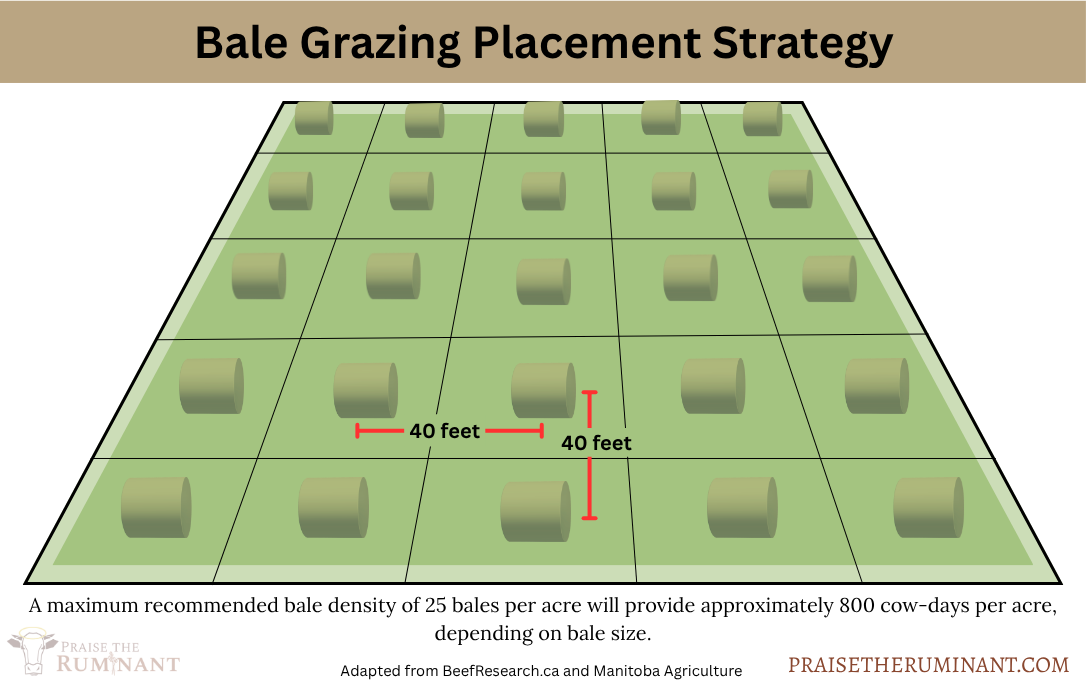
The image above shows the maximum recommended density to place bales on a per acre basis. These will give you approximately 800 cow-days per acre, assuming the bales are weighing around 1066 pounds each. (Heavier bales obviously provide higher cow-days per acre.)
For this reason it is important to weigh your hay bales or have an approximate weight per bale to better accurately determine how much forage is available to your animals. Lighter bales provides less forage for your animals which could undercut the time planned out for the bale grazing session.
Snowfall can also impact how much forage is available as well as how much waste animals may leave behind. Heavier snowfall buries bales more readily, which makes it harder for animals to access the bales and leave less waste compared to lower snowfall winters. They have to spend more energy digging for and trying to access feed through deep snow.
Minimize waste in deep snow by planning ahead: remove string prior to bale grazing, and be prepared to have the tractor out to move snow off bales and provide better access for the animals when it’s time to move them to the next paddock. Splitting bales up with electric fencing (as incorporated into the calculator below) always helps with decreasing wastage.
Notice that the calculator has expected wastage instead of utilization rate. Often the conversation around waste and wastage is more prevalent when discussing this form of winter grazing, which is why the term had to be included in the calculator.
Table 1: Crop types used for swath grazing and corn grazing
Four primary crop types that are used for swath grazing below are presented with their expected or average yields (in tons/acre and lb/acre) and typical utilization rates. Standing corn for grazing is included in this table with its average yield range and utilization rates.
| Crop Type | Utilization Rate | Expected Yield (tons/ac) | Expected Yield (lb/acre) |
|---|---|---|---|
| Barley | 58% to 92% | 1.5 to 2.5 | 3,000 to 5,000 |
| Oats | 58% to 90% | 2.0 to 3.5 | 4,000 to 7,000 |
| Triticale | 80% to 88% | 2.0 to 3.0 | 4,000 to 6,000 |
| Oat/Rape/Pea Mix | 60 to 90% | 3.5+ | over 7,900 |
| Corn (standing) | 57% to 80% | 2.6 to 8.4 | 5,200 to 16,800 |
Calculator 1: Animals Needed
Pre-existing values can be deleted and replaced with your own values found in the YELLOW highlighted fields.
Calculator 2: Number of Bales Needed
Pre-existing values can be deleted and replaced with your own values found in the YELLOW highlighted fields.